
How can parents support their younger child’s mental health? Building a tool box of strategies for your children to use when their mental health is a bit wobbly is a proactive way to equip them to manage their response as situations arise.
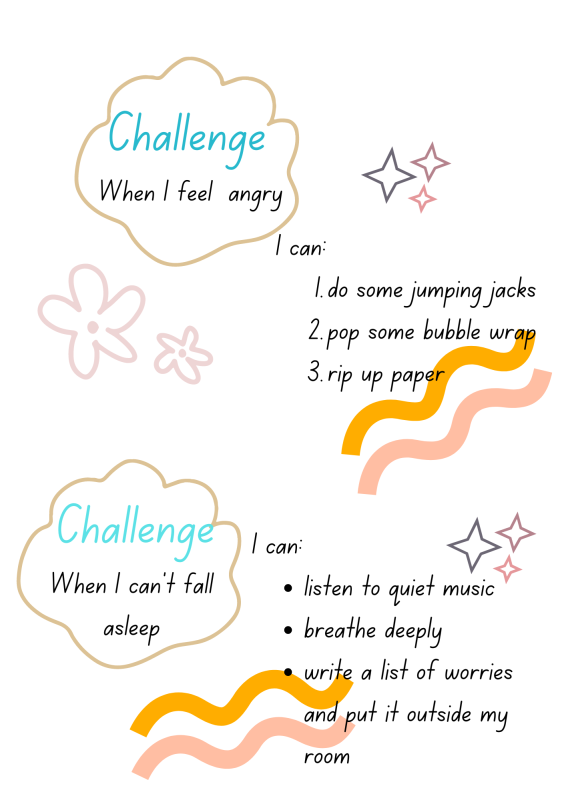
Making a chart together that lists challenging situations and corresponding practices in response is an easy, visual resource to have on hand. A simple chart, colourful pie chart, power point presentation or big poster can be cheaply made and give your child some ownership of the technique.
This chart will give you and your child a shared language. By providing a shortcut, solving an issue will be easier because you’ll just have to prompt them to remember what is on the chart rather than brainstorming in the middle of a challenge when no-one is at their best.
The list/poster/power point also gives them a wide range of strategies to choose from. Decision making is not easy when we’re destressed. Limiting the amount of options and having a visual cue will be helpful. Depending upon how distressed your child is, they may make their own choice or you can give them a few ideas to choose from.
Firstly, have a chat about specific circumstances that your child finds difficult to manage. This might be coming home from day care, being in new surroundings, conflict during lunchtime at school, or finding it hard to fall asleep.
Add these situations to your chart. If pictures are more effective with your kiddo, drawing or cutting up magazines or finding images together online are options.
Then, think of responses that would help the situation. This might be, when I feel worried at bed time, I will write my worries down and put them outside the door. Or, when my friends are mean at school, I will find some other people to play with. Or, when I am feeling fidgety, I will shake my hands for 3 seconds.
Put these alternative actions opposite the corresponding challenges to make the link between them obvious.
If your child has less robust mental health, there might be a long list of challenges. Too many will be overwhelming and ineffective. Start with 3 and see how your child responds. You can always add or subtract things over time.
How can parents support their younger child’s mental health? The aim is to give your child a tool box of strategies so that their confidence in managing issues increases, and they feel supported by you as they learn how to cope with challenges.
