
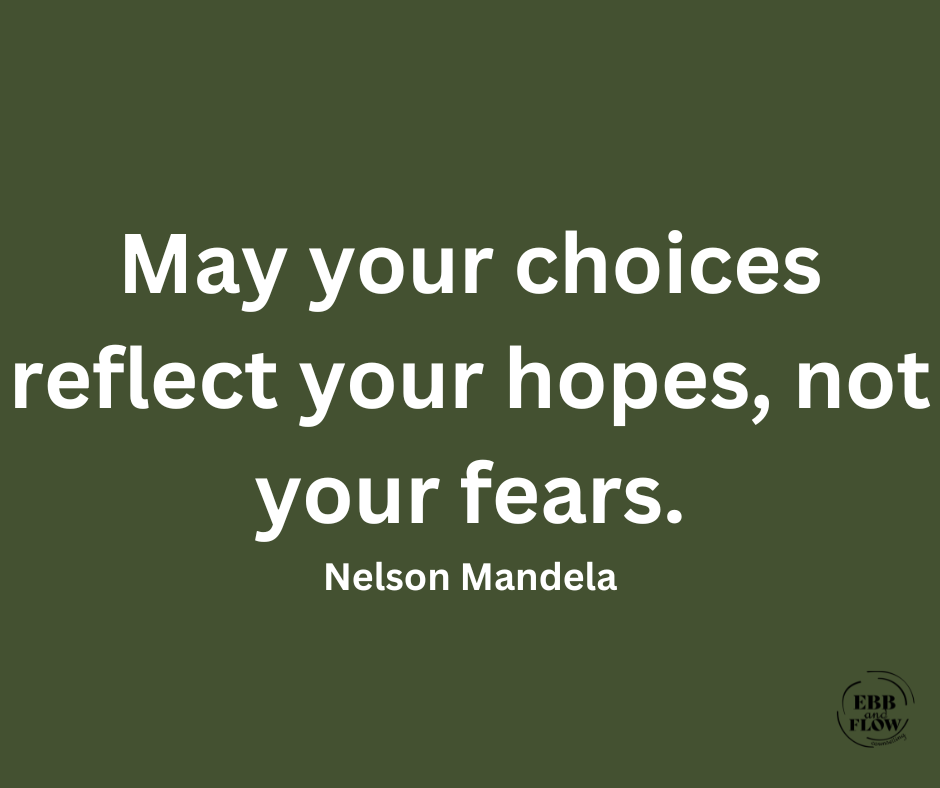
As a counsellor, I often sit with people navigating uncertainty—decisions that feel heavy, futures that seem shrouded. One phrase I return to again and again is Nelson Mandela’s gentle invitation: “May your choices reflect your hopes, not your fears.” It’s not just poetic—it’s profoundly practical.
Fear has a way of narrowing our vision. It whispers worst-case scenarios, magnifies risks, and convinces us to shrink rather than stretch. But hope? Hope expands. It invites us to imagine what’s possible, to take courageous steps, and to trust that growth is worth the discomfort.
In sessions, I often help people distinguish between unfounded fears and real concerns. The former are stories we tell ourselves—what if I fail, what if they reject me, what if I’m not enough. The latter are grounded in reality—financial strain, health issues, relational conflict. Both deserve attention, but they call for different responses.
Here’s how we can begin to shift from fear-led to hope-led living:
• Name the fear. Write it down. Speak it aloud. Fear thrives in silence.
• Ask: is this fear true, helpful, or kind? If not, it may be a story, not a fact.
• Look for the good. Train your attention on what’s working, what’s possible, what’s growing.
• Take action on real concerns. Seek support, make a plan, take one small step.
• Choose language that uplifts. “I’m learning” is more hopeful than “I’m failing.”
When we choose from hope, we honour our values, our growth, and our capacity to change. We become more resilient, more open, and more connected to others.
So today, whether you’re facing a crossroads or simply trying to get through the week, pause and ask yourself: Are my choices reflecting my hopes, or my fears?
Let this be your gentle reminder: May your choices reflect your hopes, not your fears. It’s not just a quote—it’s a way of living.
